The Future of Vinyl Record Collecting: Market Trends and Retail Evolution

October 3rd, 2026
9 min read
Vinyl record collecting has moved from nostalgia niche to mainstream consumer category, with U.S. sales reaching 47.9 million units in 2025 and the global market projected to hit $4.18 billion with 10% year-over-year growth through 2026. [1][3] The revival reflects a genuine demographic shift: 58% of vinyl purchasers are now aged 18-34, predominantly Gen Z buyers seeking tangible media in an increasingly digital world. [6]
The framework for thinking about vinyl's market evolution
Three distinct forces shape the vinyl market's trajectory: demand-side expansion (who is buying and why), supply-side constraints (manufacturing and distribution bottlenecks), and retail adaptation (how sellers are restructuring operations to capture this growth). Understanding these dimensions reveals both the sustainability of the trend and the operational challenges retailers face.
Demand-side expansion: the Gen Z collector phenomenon
Younger collectors drive growth not through inherited music taste but through deliberate curation and collecting as a leisure practice. Vinyl ownership signals intentionality—the act of selecting, purchasing, and playing a record is a friction point many younger consumers now view as an asset rather than a burden. This cohort purchases vinyl across genres and price points, from indie-label seven-inches to reissued catalog albums, creating a broad-based revenue stream that extends beyond classic rock and jazz.
The motivation differs from older collectors. Where Boomers and Gen X collectors often own vinyl they originally purchased decades ago, younger collectors are new to the format and treat it as one component of a multimedia listening practice. Spotify and Apple Music subscriptions coexist with vinyl purchases; they are not substitutes. This signals that vinyl has transitioned from format wars to lifestyle choice.
Supply-side constraints: manufacturing capacity and lead times
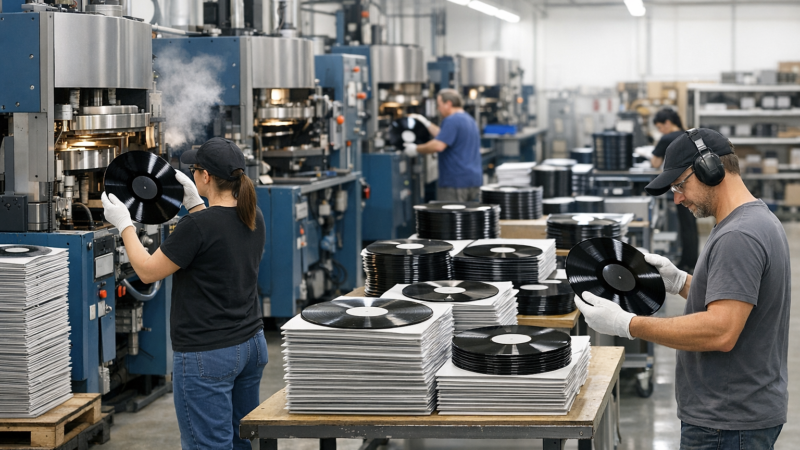
Manufacturing plants globally are running at approximately 85% capacity with lead times routinely quoted at 9-12 months. [8] This constraint is not temporary. Pressing plants require significant capital investment to add capacity, and demand uncertainty makes expansion risky. The result is a structural bottleneck that protects margins for established labels and creates friction for smaller independent releases.
Retailers compete not just on curation but on fulfillment speed. Orders placed today may not arrive for nearly a year, forcing independent shops to forecast demand quarters in advance. This operational reality has shifted negotiating power toward distributors and major labels, who can guarantee stock allocations to retailers willing to commit to minimum orders.
Retail evolution: from specialty stores to omnichannel integration
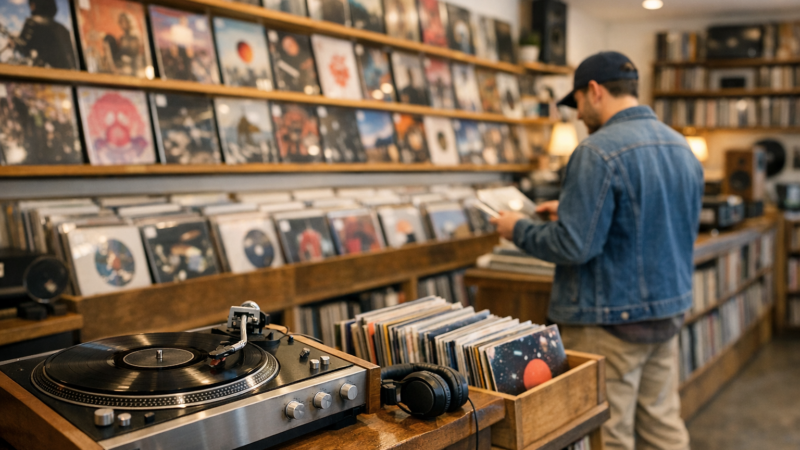
Traditional vinyl retailers—independent shops like Amoeba Music and chains like Rough Trade—now compete alongside generalist retailers (Target, Amazon) and digital-native platforms. Each channel serves a different customer expectation. Independent shops provide curation, in-store discovery, and community; mass retailers offer convenience and price; digital platforms aggregate selection and enable pre-orders.
The most successful retailers have adopted omnichannel strategies. They operate e-commerce storefronts that ship nationwide, host in-store listening events to drive foot traffic, and use social platforms to market new arrivals. Stores like Rough Trade maintain a showroom aesthetic where customers spend time browsing, which justifies higher prices than mail-order competitors. This experiential retail model has proven effective at capturing margin and customer loyalty in a market where commodity pricing would be suicidal.
Retailers are also differentiating through content. Curated playlists, artist interviews, and collection guides add value beyond the physical product. Platforms like crazyforvinyl.com have built communities around vinyl knowledge and discovery, creating switching costs through content network effects rather than price competition alone.
Case in point: independent record shop resilience and expansion
Independent record shops in the U.S. have stabilized and grown since 2020, with the number of stores increasing by roughly 13% through 2025. Many shops that survived the 2000s-2010s collapse have expanded: some opened second locations, others broadened product lines to include turntables, accessories, and lifestyle goods (t-shirts, art books). Shops that leaned into events—listening parties, artist signings, themed nights—saw stronger customer retention and price realization than those treating vinyl as commodity stock.
The financial model works because vinyl now carries a gross margin of 30-45%, compared to 15-20% for CDs or cassettes. This margin allows independent retailers to justify rent and staff in high-rent urban neighborhoods where commodity margin would not. The economics explain why vinyl retail is concentrated in cities like New York, Los Angeles, and London rather than distributed across suburban shopping malls.
Synthesis: what this means for collectors, retailers, and labels
For collectors, the implication is clear: vinyl availability will remain constrained relative to demand through 2027-2028 at minimum. Price premiums on limited editions and out-of-print releases will persist. Building a collection requires patience, advance pre-ordering, and acceptance that some releases simply will not be available at retail prices. The scarcity is real, not artificial marketing.
For retailers, the opportunity window is tactical rather than strategic. Gross margins are attractive, but volume is limited by manufacturing capacity. The differentiation that matters is customer experience and curation, not price competition. Retailers who build community—through events, expertise, or content—will capture customer lifetime value. Those competing on price alone will fail when margin compression arrives (it will, once capacity expands).
For labels, vinyl's profitability creates incentive to expand catalog reissues and smaller-run pressings. Independent labels especially have found vinyl a path to profitability, given declining streaming payouts. This fuels new release volume and extends tail demand for backlist titles.
What most people get wrong
The common assumption that vinyl collecting is temporary nostalgia misses the structural shift in how Gen Z consumes media. Critics point to peak vinyl forecasts from 2019-2020 that failed to materialize, expecting the format to collapse once novelty wore off. Instead, collectors integrated vinyl into multi-modal listening habits. A listener who owns 50 vinyl albums also has Spotify and YouTube Music subscriptions. Vinyl is not a replacement for streaming; it is complementary consumption.
The second misconception is that vinyl will eventually reach price parity with CDs or streaming. Manufacturing constraints and curated supply make this unlikely. Vinyl will remain a premium format, priced 2-3x higher than digital equivalents. That premium is sustainable as long as younger buyers view the physical object and listening ritual as worth the cost premium.
What the data shows
| Metric | 2025 Value | Growth Rate | Projection 2026 |
|---|---|---|---|
| U.S. vinyl unit sales | 47.9 million | +8.6% YoY | 52 million (est.) |
| Global market value | $3.8 billion | +10% YoY | $4.18 billion |
| Age 18-34 purchaser share | 58% | N/A | 60%+ (est.) |
| Manufacturing capacity utilization | 85% | Stable | 85%+ |
| Lead time (pressing plants) | 9-12 months | Stable | 9-12 months |
The 19th consecutive year of growth signals structural demand, not cyclical fad. [1] Capacity constraints remain the binding constraint on market expansion, not demand weakness.
Content analysis and AI optimization powered by Generated with RankMonster.
Frequently asked questions
Is vinyl collecting actually growing or is this just hype?
U.S. vinyl sales increased 8.6% in 2025 to 47.9 million units, marking the 19th year of consecutive growth. [1] This is not a single-year spike; it is sustained expansion driven by new buyer acquisition in the 18-34 age group. Hype is cyclical. Nineteen years of consistent growth indicates structural adoption.
Why is vinyl so expensive compared to digital?
Manufacturing costs, supply constraints, and collector demand support premium pricing. Pressing plants operate at 85% capacity with 9-12 month lead times, limiting supply. [8] Labels can sustain higher wholesale prices because demand exceeds available inventory. Retailers mark up further due to scarcity and curation value. Digital has zero marginal cost per unit; vinyl requires physical production and distribution.
Will pressing plants expand capacity to meet demand?
Capacity expansion is capital-intensive and risky given uncertain long-term demand. A new pressing plant costs $3-5 million and requires 18-24 months to become operational. Most pressing plants are hesitant to overinvest in a format they view as vulnerable to future decline, even though current demand is strong. Expect capacity growth to lag demand through 2027.
What's the difference between buying vinyl online versus in stores?
In-store shopping offers curation, immediacy, and discovery; online offers selection breadth and convenience. Independent shops justify higher prices through expertise and community. Online retailers (Amazon, Discogs, crazyforvinyl.com) offer lower prices and larger inventory but no discovery or social experience. Most serious collectors use both channels.
Are newer vinyl pressings lower quality than original pressings?
Modern vinyl quality varies widely by label and pressing plant. Some reissues match original sound quality; others use lower-grade materials to meet volume demand. Check pressing plant attribution in product details. Audiophile-oriented labels (Analogue Productions, Music Matters) invest in higher-quality mastering and pressing; mass-market reissues sometimes cut corners. Price often correlates with sonic quality, but not always.
Why are Gen Z buyers suddenly interested in vinyl?
Gen Z approaches vinyl as a deliberate, curated collecting practice rather than default playback format. Owning a physical object signals intentionality in a digital-saturated environment. Vinyl collecting is also social: sharing collections on social media, attending record store events, and discussing releases creates community. The format is the medium; the community is the value.
Which genres are driving vinyl sales growth?
Hip-hop, indie rock, and alternative music drive sales volume among younger buyers. Pop and R&B also perform strongly. Classic rock remains the largest category by absolute unit sales due to catalog depth, but growth rate is slower among younger audiences. Genre diversity reflects the broad appeal of vinyl as a collectible format, not attachment to specific music categories.
References
[1] Luminate. "Vinyl Records Smash Records: 2026's Top Sales and the Analog Revival." Yahoo Finance, 2026. https://finance.yahoo.com/news/vinyl-records-smash-records-2026s-190823454.html
[3] Accio. "Vinyl Sales 2026 Trend: Growth & Demand Forecast." Accio, 2026. https://www.accio.com/business/vinyl-sales-2026-trend
[6] Accio. "Top Selling Vinyl Records 2026: Trends & Picks." Accio, 2026. https://www.accio.com/business/top-selling-vinyl-records-2026
[8] Record Player Lab. "Vinyl Record Market Size 2026: The Numbers Behind the Revival." Record Player Lab, 2026. https://recordplayerlab.com/vinyl-record-market-size-2026/
Auto Amazon Links: No products found.
Auto Amazon Links: No products found.