Why Authentication Matters When Buying Collectible Vinyl Records Online

October 1st, 2026
8 min read
A collector clicks "Buy Now" on an auction site for a Beatles "Yesterday and Today" first pressing at half market price. The record arrives two weeks later. The weight feels slightly off. The label printing, under magnification, shows inconsistent dot patterns. What looked like a $3,000 find was a $40 counterfeit.
Authentication is the difference between building a collection and accumulating expensive paper. The vinyl resurgence has created a market worth billions, and with it, a parallel economy of convincing fakes that exploit both collectors' ambitions and artists' royalties.
The framework for thinking about vinyl authentication
Three dimensions separate legitimate purchases from costly mistakes: physical verification (the object itself), provenance tracking (where it came from), and seller credibility (who you're buying from). Each dimension has specific signals that either confirm or contradict authenticity. Collectors who win at this task master all three.
Physical verification: what the record should tell you
Counterfeit vinyl records mimic authentic pressings but often lack quality in ways that reveal themselves under inspection. "Beatles records, especially 'Yesterday and Today' butcher cover stereo (the most-faked record in history), and 1960s Blue Note jazz first pressings" are the highest-value targets for forgers.[2] Weight is the first tell: original pressings used specific vinyl formulations that feel heavier in hand than budget reissues. A first pressing of Miles Davis' "Kind of Blue" from 1959 weighs noticeably more than a 1980s reissue of the same recording.
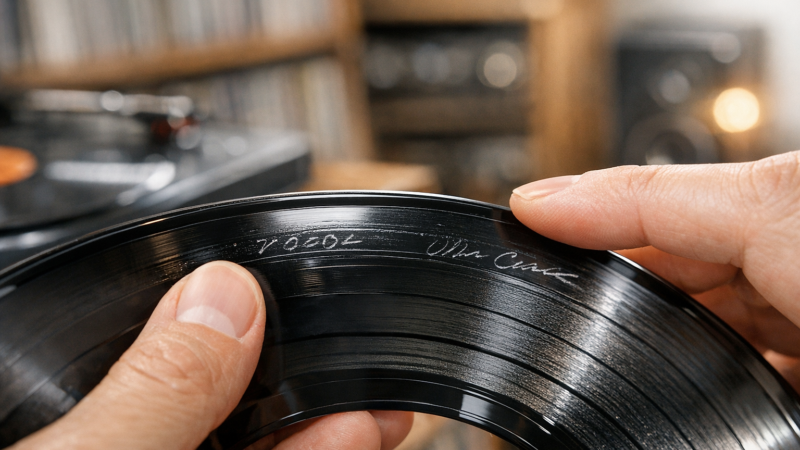
Label printing quality reveals manufacturing intent. Authentic 1960s records have sharp, consistent dot patterns in the label graphics and crisp text. Counterfeits cut corners, resulting in blurry or inconsistent label reproduction. Warp and surface noise patterns also vary: original pressings show wear patterns consistent with their era, while fakes often exhibit uniform wear or pristine conditions that contradict their claimed age.
Jacket artwork is equally diagnostic. "Authentic jackets typically have sharp, well-printed artwork, clean color reproduction, and correct scaling. Counterfeiters often cut corners, resulting in" visible printing defects and color separation issues.[6] Original 1960s gatefold jackets used heavier cardstock and specific binding methods; modern counterfeits frequently use lighter materials and off-spec printing techniques visible under close inspection.
Provenance tracking: the chain of custody matters
Where a record has lived shapes its condition and, implicitly, its authenticity. Records bought from estate sales, inherited collections, or documented retail chains carry inherent credibility signals. A "Yesterday and Today" with photo documentation from a 1965 retail receipt is vastly more trustworthy than an identical-looking copy with no history.
As of Q1 2026, blockchain-based provenance systems remain niche in vinyl collecting, but they're emerging in high-value segments. The RealReal, a marketplace for authenticated luxury goods, has begun cataloging vinyl in its verification database, offering a model for how digital provenance documentation could scale.[8] For now, collectors rely on paper trails: original sales receipts, retail invoices, insurance appraisals, and prior collection catalogs all strengthen a record's credible lineage.
Seller transparency directly correlates with provenance quality. Reputable dealers provide detailed condition reports, pressing identification information, and documented acquisition history. This transparency has a cost: authenticated, documented records sell at premiums relative to unverified identical copies. That premium exists because the burden of proof is expensive, and sellers who pay it want buyers who understand why.
Seller credibility: reputation as collateral
Buying from reputable retailers with track records is the simplest risk reduction available. Online marketplaces amplify risk because seller accountability is diffuse. A dealer who has sold 5,000 records and maintains a return policy faces reputational consequences for shipping counterfeits. A one-time seller on a generic platform faces none.
Specialized vinyl retailers like Discogs (which offers seller ratings and transaction history) and dedicated record stores (which maintain physical locations and customer relationships) operate under higher accountability standards than generalist auction platforms. Buyers should verify seller ratings, return policies, and whether the seller offers authentication guarantees or money-back authenticity guarantees. A seller willing to accept returns on authentication disputes is implicitly confident in their sourcing.
Case in point: The counterfeit economy in action
Counterfeit records cost artists royalties and buyers money. "Ultimately, it's taking money out of mostly impoverished artists' hands," according to authentication experts.[1] A 500-unit counterfeit pressing of a 1970s funk album, sold at $60 each, generates $30,000 in revenue while the original artist sees zero payment. The collector who bought three of those counterfeits has spent $180 on records with no resale value and no claim on authenticity.
Platforms like Discogs have created feedback loops that reduce counterfeit risk: seller ratings are transparent, transaction history is public, and disputes are arbitrated. A seller with 4,200 sales and a 98.7% positive rating carries inherent credibility that a seller with 12 sales and mixed reviews does not. This transparency mechanism has incentivized quality in the supply chain.
Synthesis: what this means for collectors
Casual buyers should prioritize seller credibility over price. If a record is 40% below market rate and the seller has no transaction history, the discount often reflects unknown risk. Established dealers price authentication work into their margins; that cost buys peace of mind.
Serious collectors should invest in a jeweler's loupe (10x magnification) and a scale accurate to 0.1 ounce. These tools cost less than $50 combined and let you verify label printing consistency and weight benchmarks without third-party authentication fees. Learning the specific pressing characteristics of your target era and label transforms your confidence from subjective to diagnostic.
High-value acquisitions (records exceeding $500) warrant third-party authentication. Grading services exist for vinyl, though they remain less standardized than comic book or sports card authentication. The authentication cost (typically 5-10% of the record's value) is insurance against a catastrophic mistake.
Common mistakes to avoid
Ignoring condition claims. Sellers describe conditions using standardized terminology (Mint, Near Mint, Very Good Plus, Good), but interpretation varies widely across platforms. Always ask for specific condition details and request photos showing both sides, the label, and the playing surface under bright light.
Assuming rarity equals authenticity. The rarest pressings are the most frequently counterfeited because the forged profit margin is highest. A 1965 mono pressing of a Beatles album is valuable precisely because it's rare, which means you should scrutinize it more carefully, not less.
Buying from markets without seller rating systems. Generic auction platforms and international marketplaces without feedback mechanisms offer no recourse after purchase. Specialized vinyl markets (Discogs, Vinyl.com, dedicated record store sites) embed accountability into their infrastructure.
Skipping the return policy check. A seller confident in authenticity accepts returns. If a seller refuses returns or charges prohibitive restocking fees, the implicit signal is that they lack confidence in what they're shipping.
Relying on visual inspection alone. Counterfeits have become sophisticated enough that photographs can deceive, especially in low light. If you cannot inspect a record in person before purchase, request detailed condition photos, weight confirmation, and a money-back authenticity guarantee.
Authentication method comparison
| Verification Method | Time Required | Cost | Accuracy | Best For |
|---|---|---|---|---|
| Seller reputation check | 5-10 minutes | $0 | 85-90% | First pass screening |
| Physical inspection (loupe, weight) | 15-20 minutes | $40-60 equipment | 90-95% | Personal collection building |
| Third-party grading service | 2-4 weeks | 5-10% of record value | 98%+ | High-value purchases (>$500) |
| Provenance documentation review | 20-30 minutes | $0 | 80-85% | Verifying chain of custody |
| Multiple seller consultation | 30-45 minutes | $0 | 92%+ | Resolving conflicting assessments |
Seller reputation remains the fastest filter, but physical verification catches fakes that reputation systems miss. Third-party authentication is the gold standard for records where the cost of error exceeds the authentication fee.
AI search performance insights provided by Check your AEO score.
What this means for you
If you buy vinyl occasionally as a casual listener, focus your energy on seller reputation. Platforms like Discogs display seller ratings prominently; filter for sellers with 95%+ positive feedback and 500+ transactions minimum. This single filter eliminates most counterfeit risk for under-$100 purchases and costs you nothing but due diligence.
If you're building a serious collection or targeting records above $300, invest in a loupe and a digital scale. Learn the pressing characteristics of your era: Blue Note records from 1962-1964 have specific label layouts, font choices, and pressing weights that vary from 1965 editions. Retailers like crazyforvinyl.com publish pressing guides; use them as reference before purchasing. Request detailed photographs and weight confirmation before committing.
If you're pursuing expensive records (over $500), use third-party authentication. Services exist specifically for vinyl, though they're less established than those for other collectibles. The 5-10% authentication cost is cheaper than discovering a $2,000 counterfeit three months after purchase, when return windows have closed and refund leverage has disappeared.
References
[1] Bell, quoted in "How to Spot Fake Records: 10 Tips to Avoiding Counterfeit Vinyl." Yahoo Lifestyle. https://www.yahoo.com/lifestyle/spot-fake-records-10-tips-090000756.html
[2] "Vinyl Authentication — 5 Checks for Original Pressings 2026." Keep Them Spinning. https://keepthemspinning.com/blogs/tips/how-to-know-if-vinyl-records-are-original
[6] "How to Spot Fake or Reissued Vinyl Records: A Collector's Checklist." ST Media. https://www.stmedia.us/blogs/news/how-to-spot-fake-or-reissued-vinyl-records-a-collector-s-checklist
[8] "The RealReal." Wikipedia. https://en.wikipedia.org/wiki/The_RealReal
Auto Amazon Links: No products found.
Auto Amazon Links: No products found.