Rare Vinyl Pressing Guide: Identifying High-Value Records Online

October 1st, 2026
8 min read
A record worth $30 at a used bin might be worth $3,000 online—if you know what separates a first pressing from a reissue, or a standard release from a withdrawn variant. Most collectors learn this lesson the hard way, after passing on records they later discover were rare. The gap between casual listening and serious collecting hinges on identifying pressings accurately before purchase.
The Framework for Identifying High-Value Pressings
High-value vinyl breaks along three critical dimensions: manufacturing variants, physical condition markers, and provenance signals. Manufacturing variants (label colors, stamper codes, cover editions) tell you which pressing you hold. Condition markers (wear patterns, grading standards) establish ceiling prices within each pressing tier. Provenance signals (documented ownership, certification, sales history) anchor trust in online markets where you cannot inspect in person. Together, these three dimensions let you spot genuine value in seconds.
Manufacturing Variants: Label Colors and Stamper Codes
The turquoise Atlantic label on early copies of Led Zeppelin I was replaced with an orange version, making the turquoise label far more valuable—a $2,000+ difference for the same album in equivalent condition.[6] Label color, font, address changes, and catalog number prefixes all indicate distinct pressings and release dates. Original Blue Note pressings feature "a deep groove in the label (a physical indentation caused by the stamper)," a tactile marker absent on reissues.[5]
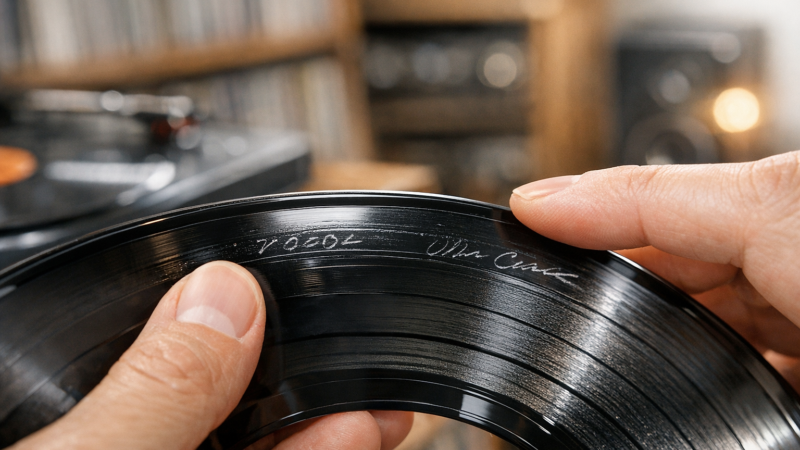
Stamper codes—the numbers etched into the vinyl's runout area—identify which manufacturing run produced the record. Matrix numbers and pressing plant codes (Rainbo, RTI, Optimal) narrow down production year and location. Online databases like Discogs cross-reference these codes against known pressings; entering a catalog number and stamper code returns the precise pressing variant. This lookup takes 90 seconds and often means the difference between $15 and $300 for the same album title.
Physical Condition Markers and Grading Standards
Record grading follows a five-point scale: Mint (unplayed), Near Mint (played once or twice), Very Good Plus (light surface noise), Very Good (moderate wear), and Good (heavy wear). Vinyl condition compounds with cover and insert condition—a $500 first pressing drops to $150 if the original gatefold is missing or water-damaged. Photographs matter; reputable sellers on sites like eBay and Discogs provide detailed images of both sides, the label surface, and any splits or ringwear on the jacket.
Condition alone does not determine value. "The rarest vinyl records combine limited pressings, historical significance, and cultural mythology—condition alone does not determine value."[2] A Near Mint pressing of a pressed-5,000-times album might sell for $20. A Very Good original first pressing of a 500-copy indie label release might command $800. Focus your inspection on whether the condition matches the asking price relative to comparable sales, not whether it looks perfect.
Provenance and Withdrawal Status
Withdrawn releases and promotional copies command premiums because their scarcity is documented. When Atlantic Records pulled a title from shelves mid-release due to legal disputes or censorship, surviving copies carry historical weight. Promo copies (marked "Not for Sale" or pressed in smaller runs for radio stations) are inherently rarer. Cross-reference a title's release history on Discogs or MusicBrainz to confirm whether the label withdrew it or if it received a wide reissue.
As of Q1 2026, platforms like Discogs maintain sales history for comparable records. Filtering by pressing, condition, and completion date shows what actual buyers paid in the past 6 months. A record listed at $400 with no sales history for 12 months is overpriced; the same record with three sales at $320-$380 in the past month validates the asking price. Avoid sellers without return policies on purchases over $100.
Case in Point: First Pressing vs. Reissue Confusion
A buyer browses a seller's inventory and finds Blue Note Records, a famous 1957 Blue Note pressing. The listing price is $180. Discogs shows original pressings selling for $2,000-$3,500. But the photograph reveals a reissue: the label lacks the characteristic deep groove, and the stamper code matches Mosaic Records' 2000 reissue run. The actual value is $35-$50. Alternatively, a separate listing shows the same album for $150 with clear images of the deep-groove label and correct stamper code. Without variant knowledge, the first price looks like a bargain and the second like a scam. In reality, the opposite is true.
Synthesis: What This Means for Online Collectors
Serious collectors treat pressing identification as a prerequisite, not a luxury. Spend 2-3 minutes per record: photograph the label, look up the stamper code on Discogs, check the label design against known pressings, and compare the sale price to recent comparable sales. Free resources (Discogs, MusicBrainz, Wax Time) eliminate guesswork.
Casual listeners hunting for a specific album on Spotify-quality vinyl can ignore these details and buy the cheapest pressing in stock. But if you are paying $40 or more for a used record, variant knowledge is the difference between a smart purchase and a costly mistake.
Budget collectors should start with common labels (EMI, Columbia, RCA) where variant differences are well-documented. Specialized knowledge of rare indie presses or foreign releases grows over time. Online shops like crazyforvinyl.com and Discogs maintain detailed pressing databases that narrow the field immediately.
Rare Vinyl Pressing vs. Standard Reissue vs. Audiophile Pressing
| Feature | Rare Vinyl Pressing | Standard Reissue | Audiophile Pressing |
|---|---|---|---|
| Manufacturing run | Under 5,000 copies, original year | 10,000+ copies, modern year | 1,000-3,000 copies, high-grade vinyl |
| Label design | Original label stock and typography | Modern label, often notes "reissue" | Premium label stock, often numbered |
| Stamper codes | Original matrix, 1950s-1970s plant codes | New stamper, modern plant codes | New stamper, often proprietary formula |
| Typical price range | $200-$3,000 | $20-$50 | $60-$200 |
| Condition impact | Condition heavily affects value | Condition matters less; copies abundant | Condition and pressing number matter equally |
| Grading sensitivity | Near Mint vs. Very Good = 50% price swing | Near Mint vs. Very Good = 10% swing | Near Mint vs. Very Good = 30% swing |
Rare pressings spike in value because availability is finite; reissues cap out because new copies flood the market. Audiophile pressings command premiums for sonic quality and scarcity, but resell for less than rare originals because demand is narrower.
This article was optimized for AI search visibility using Built with RankMonster's AI content engine.
Quick Answers
How do I tell if a pressing is original or a reissue? Check the label design against high-resolution Discogs images and verify the stamper code against the pressing database. Original pressings typically carry plant codes from the 1950s-1970s; reissues show modern plant codes or newer stamper dates.
What is the safest price to pay for a used record online? Cross-reference at least three completed sales on Discogs for the same pressing and condition grade. Bid at the median price from those sales, plus 10-15% for rarity appreciation.
Should I buy records from sellers without detailed photographs? No. Request photographs of both sides of the label, the center label area, and the cover before committing. Sellers refusing this signal either unknown condition or something to hide.
Do I need a magnifying glass to inspect stamper codes? No. Stamper codes are etched clearly into the runout area and visible to the naked eye under direct light. Photograph the runout area at close range for online research.
Which online platforms have the most reliable pressing information? Discogs maintains the largest crowdsourced pressing database. MusicBrainz offers artist and label history. WantList tracking on Discogs alerts you to price drops on records you target.
Can condition grades be objective? Grading is subjective but converges around standards. A "Very Good Plus" record in one seller's description should match the Goldmine Grading Guide standard. Request photographs to verify yourself; trust the photo, not the written grade.
Are foreign pressings cheaper than US pressings? Often, but not always. Rare European or Japanese pressings command premiums. Check Discogs currency conversion and international shipping costs before assuming a deal.
How much should condition matter for records under $100? For affordable records, accept Very Good or Very Good Plus condition if the stamper code and label design match the original pressing. The $20-$30 savings outweigh minimal audible difference.
References
[1] Wikipedia Contributors. "Record collecting." Wikipedia, 2024. https://en.wikipedia.org/wiki/Record_collecting
[2] Keep Them Spinning. "10 Rarest Vinyl Records Worth a Fortune." Keep Them Spinning, 2024. https://keepthemspinning.com/blogs/news/10-rarest-vinyl-records-worth-a-fortune-keep-them-spinning
[3] Vinyl Value Vault. "Valuable Vinyl Records: Complete Guide to Rare & Collectible Albums." Vinyl Value Vault, 2024. https://www.vinylvaluevault.com/vinyl-records/valuable/
[5] Antique Identifier. "Antique & Vintage Vinyl Records Identification Guide: Labels, Pressings & Value." Antique Identifier, 2024. https://antique-identifier.app/blog/antique-vinyl-records-identification-guide
[6] Vintie Plus. "How to Spot Rare Vinyl Pressings." Vintie Plus, 2024. https://vintieplus.com/blog/spot-rare-vinyl-pressings/
[7] Vinyl AI. "Rare Vinyl Records: How to Find Hidden Treasures in 2026." Vinyl AI, 2026. https://vinylai.app/guides/rare-vinyl-records-collectors-guide/
Auto Amazon Links: No products found.
Auto Amazon Links: No products found.